
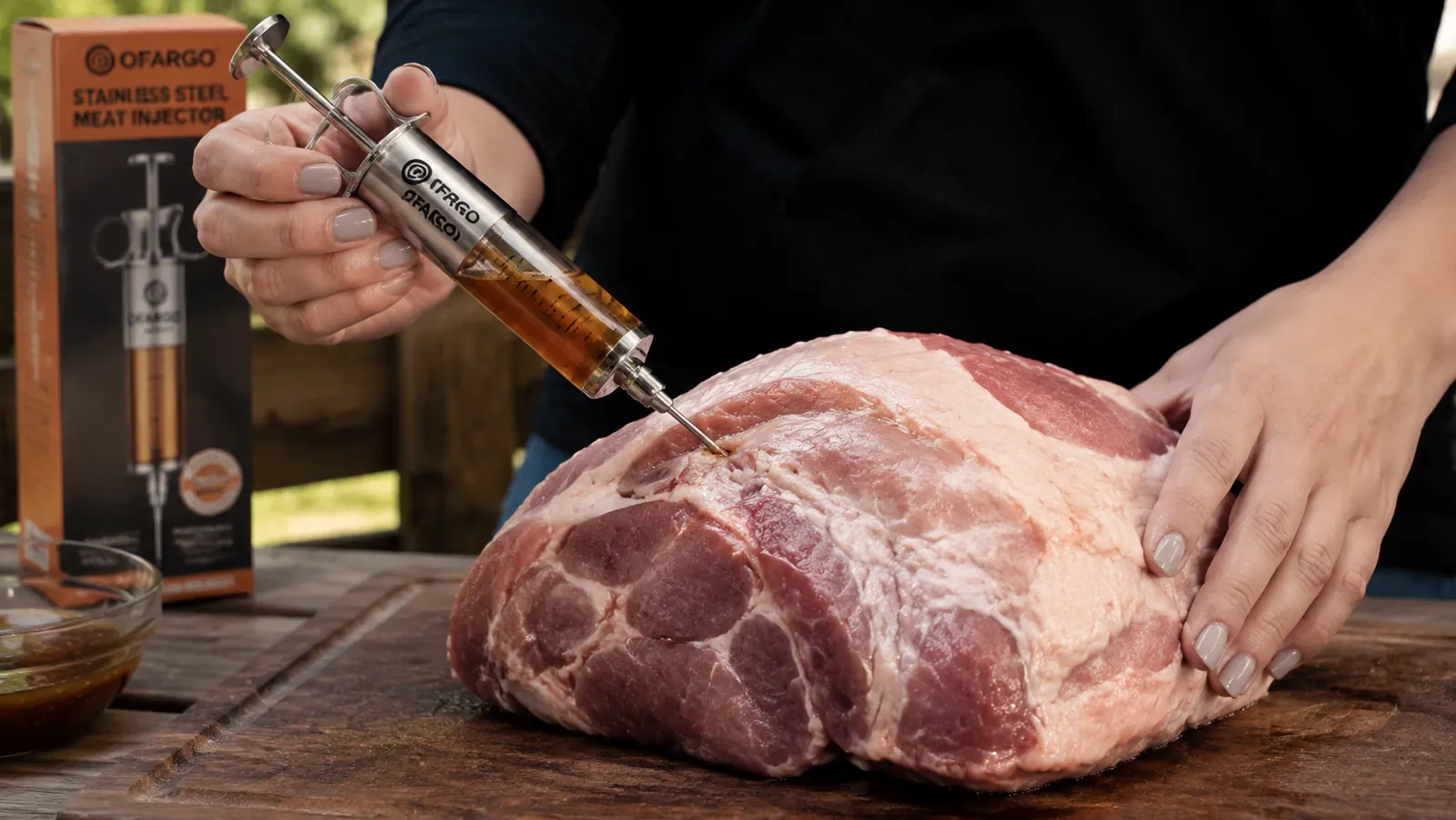
Let me tell you what the five-star reviews on the Ofargo meat injector won't. The first time I tried injecting a pork shoulder with a garlic-herb butter marinade, the needle clogged on the third injection. I pulled the plunger back to clear it, fired again, and watched a small geyser of hot butter shoot sideways across my cutting board and onto my shirt. That was a Tuesday morning in late May, about 20 minutes before I needed to get the shoulder on the smoker for a Memorial Day cookout. Nobody writes about that in their review.
I want to be straight with you before we go any further: the Ofargo stainless steel injector kit is genuinely good. The 4.7 stars and over 5,600 reviews on Amazon are earned. But there is a real learning curve here, and a handful of situations where this tool will frustrate you rather than help you. This review covers those honestly. The clogging realities, the needle matching, the cleaning routine that keeps it running, and the cooks where you're honestly better off skipping the injector entirely.
The Quick Verdict
A well-built kit that delivers real flavor payoff, but thick marinades and skipping the cleaning steps will turn it into a clog-prone headache faster than any review will warn you.
Amazon Check Today's Price →If your pork shoulder comes out dry in the center, this is the fix. Check today's price before you start your next cook.
The Ofargo kit ships with all 4 needle types and a cleaning brush. It's the one injector setup that handles everything from thin apple juice to thicker butter marinades, provided you match the needle to the liquid.
Amazon Check Today's Price on Amazon →What I Was Hoping It Would Do
My problem coming into this was straightforward. My pulled pork always had great bark and good smoke flavor on the outside, but cut into the center of an 8-pound Boston butt and it was noticeably drier than the outer two inches. I'd tried spritzing, I'd tried wrapping earlier, I'd tried injecting with a cheap plastic syringe from a kitchen store that snapped at the needle collar on the second cook. The Ofargo stainless kit looked like the right upgrade. Stainless barrel, four different needle styles, a rubber O-ring gasket to prevent blowback, and a cleaning brush kit. On paper it was exactly what I needed.
What I didn't fully appreciate before I opened the box was that a four-needle kit is really four different tools that each require a different marinade and a different technique. Using the wrong needle with the wrong liquid is the single fastest path to a clogged syringe and a frustrating morning.
The Four Needles: What Each One Actually Does (and Where Each One Fails)
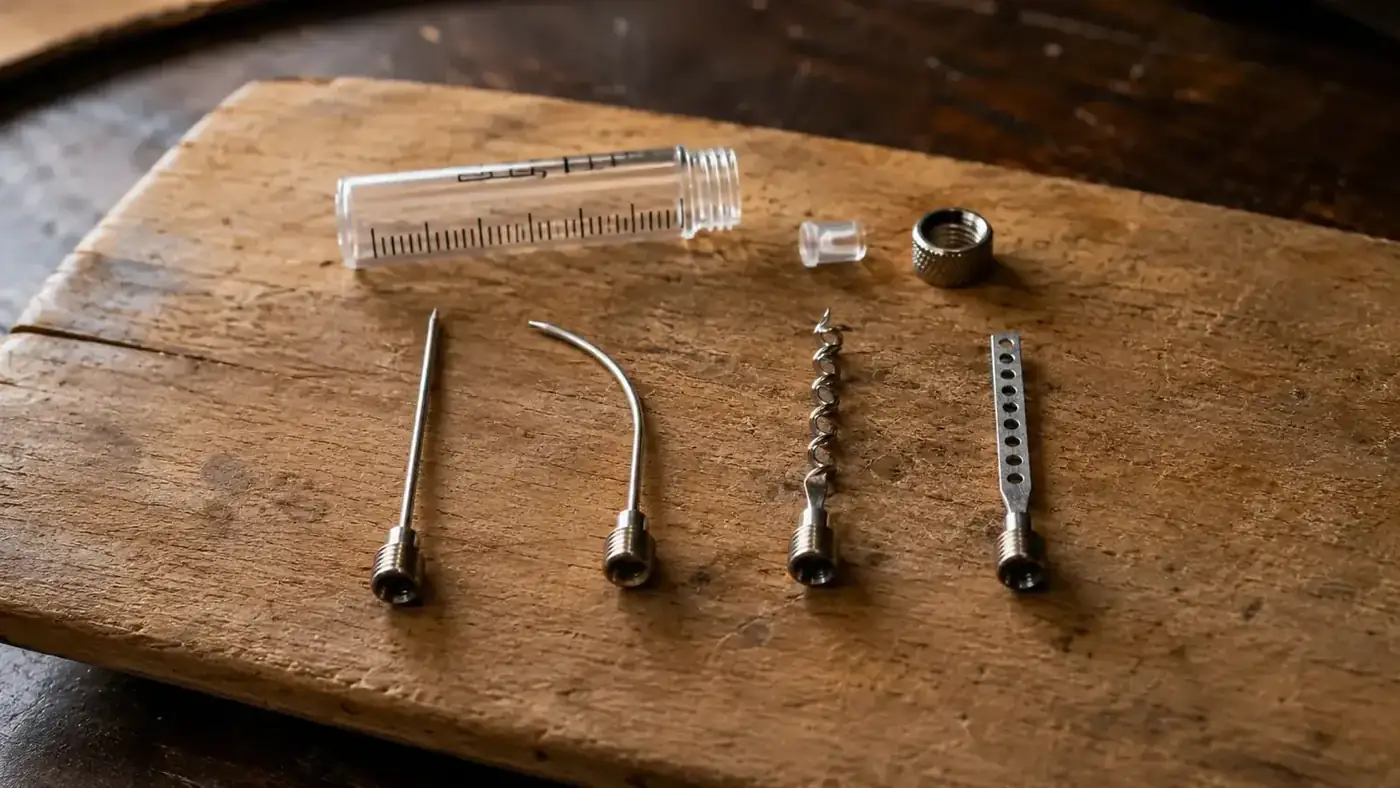
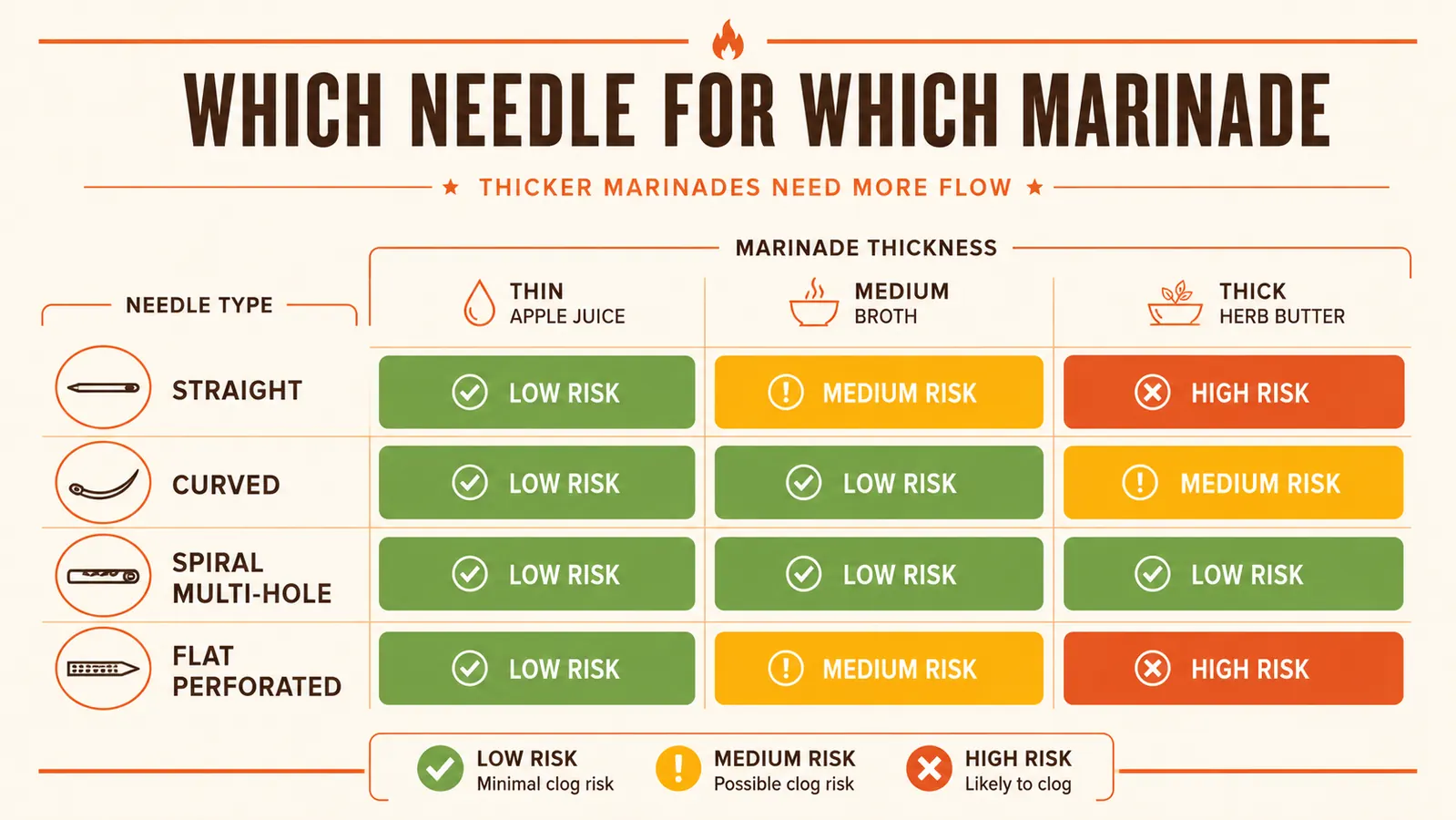
The Ofargo kit includes four needle types. There's a straight needle with a single opening at the tip, a curved needle (same tip, bent about 30 degrees), a spiral multi-hole needle where the openings run up the sides of the shaft, and a flat wide-bore needle with a series of perforations along its flat face. Each one is supposed to handle different jobs, and that is mostly true.
The straight tip is your workhorse for thin liquids: apple juice, plain broth, thin soy-based marinades. It flows freely, it's easy to clean, and it drives deep into a thick cut without much resistance. The curved version does the same job but gives you a better angle when you're working around a bone, like on a whole chicken breast or a leg of lamb. These two needles gave me zero clog problems as long as I kept the marinade thin enough to run through a coffee straw without effort.
The spiral multi-hole needle is where things get interesting and occasionally aggravating. It disperses the marinade across a wider radius with each injection, which means fewer insertion points and more even distribution. It works beautifully with a medium-body marinade, a good pork or beef broth with Worcestershire and a little melted butter. The problem shows up the moment any particle larger than a grain of sand enters the barrel. Minced garlic, dried herbs, even coarse black pepper will wedge into one of those side holes and slow the flow to a trickle within two or three injections. I learned to strain every marinade through a fine mesh strainer before loading this needle. That extra step adds maybe three minutes and eliminates the clog problem completely.
The flat perforated needle is designed for injecting compound butters and thicker slurries. It has the widest internal bore of the four, and in theory it should handle thicker stuff. In practice it still needs you to melt your butter completely and keep it warm, not just softened. If your herb butter drops below about 130 degrees Fahrenheit while you're working, it will start to firm up inside the needle and you'll get a partial blockage that makes the plunger go hard and jerky. The fix is simple: keep a small bowl of hot water nearby and flush the needle between every three or four injections. Once I built that habit in, the flat needle worked fine.
Strain your marinade before loading any needle that has side holes. That one step eliminated probably 80 percent of my clogging problems.
The Honest Clogging Reality
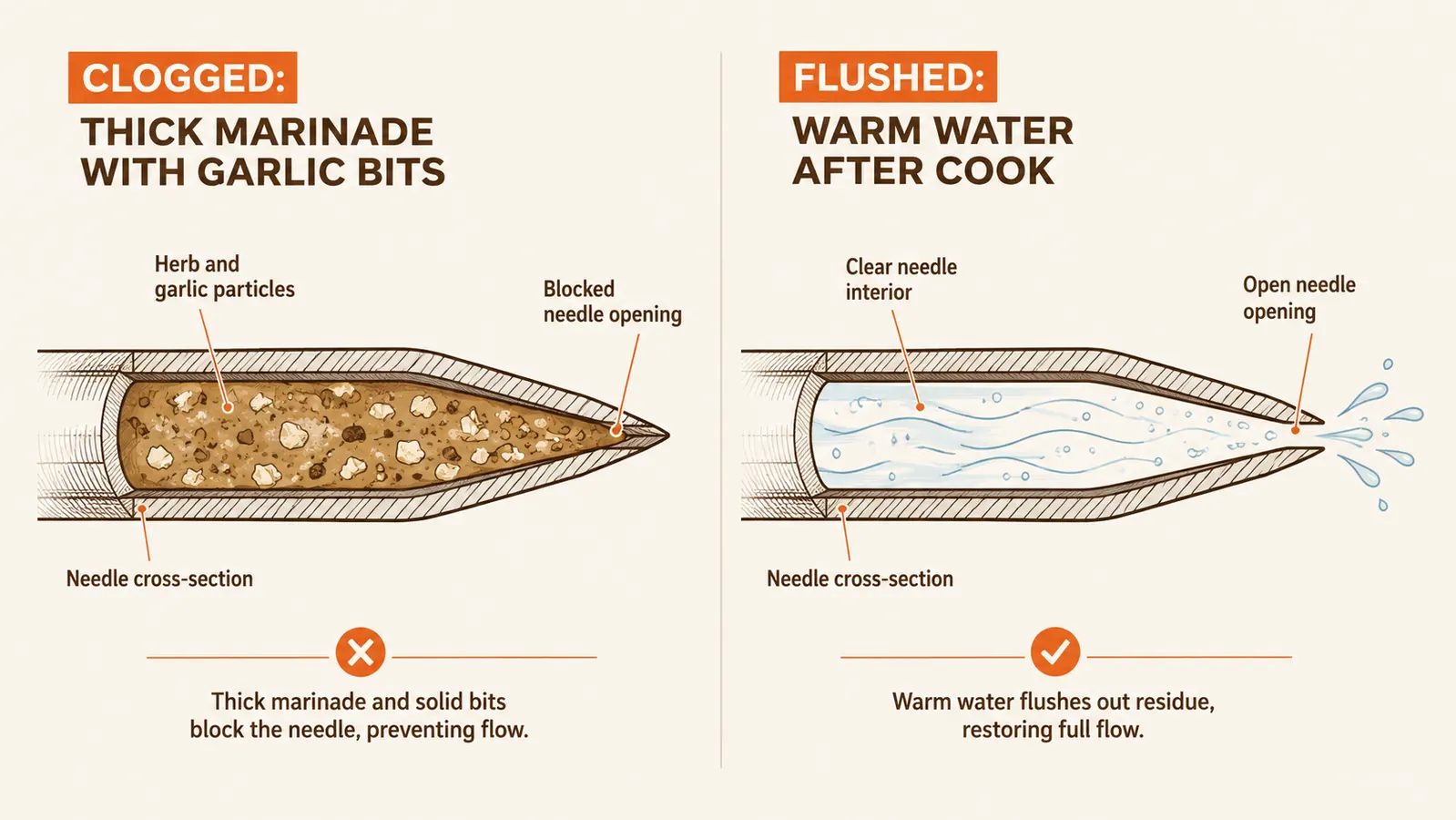
Here is the part most reviews skip. The Ofargo injector does clog, and it clogs more readily than the single-needle plastic injectors most people started with. This is not entirely a design flaw. It's partly a physics problem. More needle surface area and more holes mean more places for thick marinades to deposit residue and create resistance. If you load the barrel with a chunky marinade and drive a spiral needle into cold meat straight from the refrigerator, you are going to feel the plunger stiffen up within the first few injections.
The practical fixes are simple once you know them. Let the meat sit at room temperature for at least 30 minutes before you inject. Warm your marinade so it flows like water, not like syrup. Strain out any particles. And pull the plunger back a half-inch between injections to relieve pressure rather than just driving forward continuously. Those four habits turned clogging from a regular frustration into a rare occurrence for me.
The one scenario I haven't been able to fully solve is injecting compound butter into a cold whole turkey from the refrigerator the morning of a cook. The butter firms up almost immediately inside the cavity of a cold bird, and no amount of pre-warming the marinade fully compensates. For that specific situation, I now either use a thin melted butter with herbs strained out, or I separate the skin and rub the compound butter in by hand the old-fashioned way. The injector sits out for that cook.
Cleaning: What Happens If You Skip It Once
The Ofargo kit ships with a small wire cleaning brush that fits inside the needle barrel. Do not ignore it. The first time I ran the needles through the dishwasher without pre-flushing them, the heat baked a thin film of butter and broth residue onto the inside of the spiral needle's side holes. I didn't notice until the next cook when the flow was sluggish from the first injection. It took ten minutes of soaking in hot soapy water and working the brush through each hole to clear it.
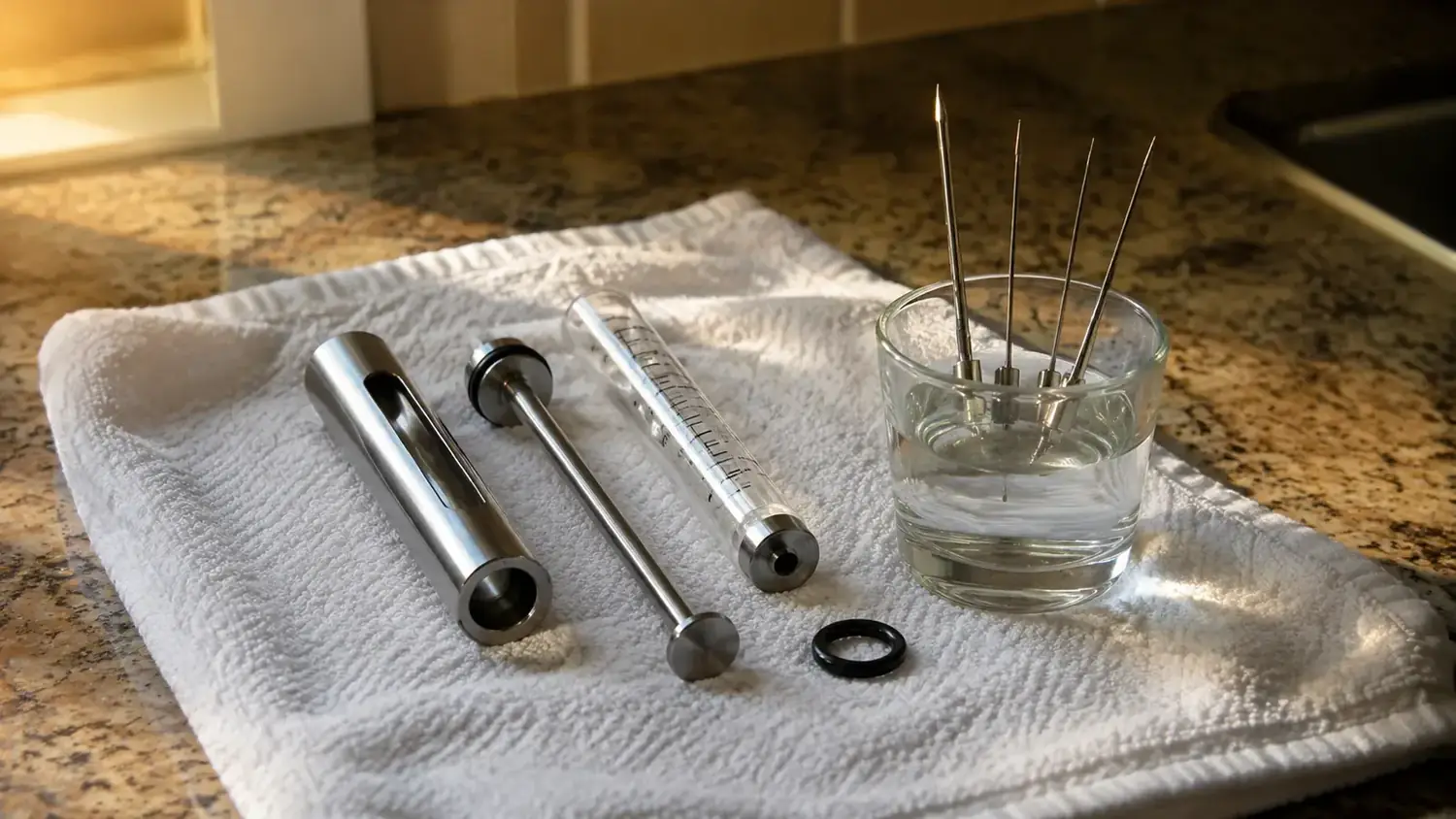
My current routine: immediately after the last injection, I pull the plunger all the way back, draw a barrel full of hot tap water, and flush it through the needle twice. Then I disassemble the barrel, remove the O-ring, and let everything air dry on a dish towel. Total time is about four minutes. If I'm doing a longer cook and I'll use the injector again the next week, I store the needles with the tips pointing up in a small glass, not loose in the box where the tips get nicked against each other.
The dishwasher question is worth addressing directly because the product listing says it's dishwasher safe. Technically yes. Practically, the repeated high-heat cycles will eventually compromise the rubber O-ring, and a worn O-ring means blowback at the barrel joint when you push the plunger. I've been hand-washing mine and the O-ring is still in good shape after around 30 cooks. I'd rather spend four minutes hand-washing than replace the kit early.
The Learning Curve Is Real, But It's Short
I want to give you an honest picture of how many cooks it takes before using this injector feels natural. For me it was about four. The first cook was the shirt-soaking herb-butter disaster I described at the start. The second cook I clogged the spiral needle twice and lost some of my marinade to a blowback at the collar. The third cook I started using the strainer and warming the marinade properly, and things clicked. By the fourth cook it felt like muscle memory.
The things you're actually learning aren't complicated. They're mostly tactile: how much back-pressure to expect from each needle, how hard to push the plunger before you should stop and clear it, how to angle the needle so it rides along a bone rather than fighting it. None of this is hard. It just requires a couple of cooks to get calibrated. If you expect to open the box and nail it on the first pork shoulder, you may be disappointed. If you expect a short learning curve followed by noticeably juicier results, that's exactly what you'll get.
What I Liked
- All-stainless construction holds up to repeated use and won't crack at the needle collar like plastic injectors
- Four needle types genuinely cover different jobs: thin liquids, around bones, wide distribution, thick butters
- The included cleaning brush is sized right and actually reaches the side holes on the spiral needle
- Barrel capacity is generous enough to inject a full pork shoulder without constant refilling
- The rubber O-ring gasket prevents blowback at the joint when it's in good condition
Where It Falls Short
- The spiral multi-hole needle clogs on any marinade with particles; straining is mandatory, not optional
- Dishwasher use degrades the O-ring over time, despite the dishwasher-safe claim
- The learning curve on pressure and technique takes 3-4 cooks to get through
- Compound butter injections into cold whole turkey are genuinely difficult; better to hand-rub in that case
- The four-needle kit requires more cleaning steps than a single-needle injector
Who This Is For
You are going to get real value from the Ofargo injector if you regularly cook large cuts that take more than 4 hours on the smoker or grill. A full pork shoulder, a whole brisket flat or packer, a whole chicken or turkey over 12 pounds. These are the cuts where surface seasoning simply cannot reach the center before the cook is done, and injection is the only way to get flavor and retained moisture all the way through. If that's your regular weekend cook, this kit is built for you and it will pay off within the first two or three uses.
It also makes sense if you've already tried injection with a cheaper plastic syringe and got frustrated with the barrel cracking or the needle pulling loose at the collar. The stainless construction solves both of those problems permanently. There's no flex at the joint, no cracking, and no wobble at the needle connection point.
Who Should Skip It
If your typical backyard cook is chicken pieces, burgers, steaks, or anything under 2 pounds, you do not need an injector. These cuts cook fast enough that a good dry rub or a surface marinade does the job, and the extra moisture from injection tends to steam the surface rather than help it. Your bark will actually suffer on a thin pork chop that's been injected. Save the tool for the big cuts.
I'd also steer away from this kit if you're the kind of cook who puts everything in the dishwasher and moves on. The cleaning requirement is real, and skipping it will shorten the life of the O-ring and leave residue buildup in the needle holes that progressively worsens clog problems. If four minutes of hand-washing after a cook sounds like too much maintenance, a simpler single-needle plastic injector might fit your routine better.
Finally, if you primarily do competition-style cooks where your injection marinade contains whole herbs, chunks of aromatics, or coarse grinds, you'll need a different tool. The Ofargo handles strained liquids and smooth butters. Anything with visible texture will fight you.
The Honest Verdict After Roughly 30 Cooks
The Memorial Day shoulder that started with a butter-soaked shirt ended with the juiciest pulled pork I had made up to that point. My neighbor Dave asked what I did differently and I had to explain the whole injector situation, the shirt and all. That's a pretty good summary of where this tool lands for me: there's a real learning tax in the first few uses, and the cleaning discipline is non-negotiable, but the output is noticeably better on every large cut I've used it on since.
The 4.7-star rating is fair. I'd probably land at about 4.5 stars if I'm being honest about the clogging reality and the O-ring sensitivity. It's not the effortless plug-and-play experience the listing implies. But for a West Texas weekend cook who's doing a pork shoulder or brisket three or four times a summer, it's the right tool once you get through those first few cooks.
Tired of dry centers on pork shoulder and brisket? The Ofargo kit fixes that, once you know the cleaning routine.
Worth checking today's price on Amazon. The four-needle kit is a genuine upgrade over single-needle plastic injectors, and the cleaning brush it ships with is the one piece most competing kits leave out.
Amazon Check Today's Price on Amazon →